A baby octopus from our lab. Very cute, but also very poisonous so no touching. We released this little one back into the ocean yesterday morning.
I really appreciate everyone being so kind to a “non-traditional student.” (Yes, I will be taking the exams for a grade – and am hoping for a C! I’m pretty good at learning new things, but don’t know beans about these Salish Sea critters – yet. Ask me a cell biology or genetics question and it would be a different story.) It is a blast to be a student again. A lot easier than being the professor, I can tell you! And maybe more fun…
In our first bot class, Charley O’Kelly gave the greatest definition of science ever: “Science is structured imagination!” Loved it. Great way to start us off on this intellectual journey. I’m glad we’re in it together.
The new ZooBot class arrived yesterday as the spring quarter gets rolling. Most of the students are from the University of Washington, but we also have visitors from Minnesota, Arizona and Taiwan. Students will take two courses, Marine Botany and Marine Zoology, in addition to undertaking an original research project as part of the apprenticeship program. The ZooBot quarter provides a combination of lecture, lab and field work for students as they explore the biology surrounding San Juan Island. Importantly, our students will also spend time at local schools sharing what they have learned with younger students in an effort to provide scientific outreach.
So, check back regularly to read updates from the world of these marine biologists.
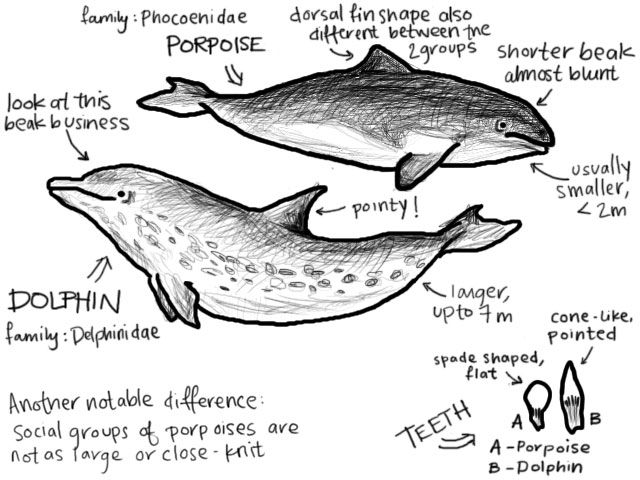
Until a week ago, I could not have told you the difference between a porpoise and a dolphin, and in fact, would have used the terms interchangeably.
No longer, my friends! I have been learninated!
At the Whale Museum last week I finally discovered the differences between these two types of cetacean. I’ve summed it all up with an illustration I made, because until I saw the two next to each other at the whale museum, I wasn’t very clear on the differences.
Copyright: M. Rock 2009
==============================================
Rate this review (click
here)
==============================================
Undoubtedly the darlings of Pacific Northwest megafauna, whales have captured our imagination for centuries. Vicious killers, gentle grazers, awe-inspiring and reverent, whales have filled human culture with imagery and lore that persists to this day. But are whales truly the first and only ’monster-mammals’ of the Salish Sea? I undertook to discover other inhabitants of our mysterious waters and along the way, found myself face-to-flipper with a behemoth that vanished from our midst centuries ago.
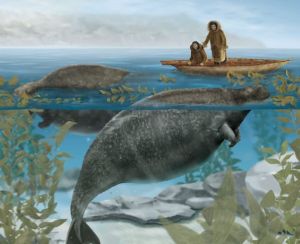
Imagine yourself perched above the intertidal, kelp below slowly bobbing in the gentle waves when suddenly you see an enormous form floating around the corner. At first you think it might be a capsized boat, until you realize that it’s moving with purpose. A porpoise, then? A huge seal or a small whale? The creature slides slowly through the water and approaches the shore. You can barely believe your eyes as the enormous animal heads for the nearest rock and pulls its bulk partially out of the water with small front flippers. Its black skin shines in the sunlight as it absentmindedly masticates a tangled blade of kelp. You have just been fortunate enough to glimpse Hydrodamalis gigas or, Steller’s Sea Cow.
Unfortunately such a scenario is all but impossible in modern times as the last known Steller’s Sea Cows became extinct in 1768, a mere 27 years after their ‘discovery’ in the Commander Islands by a group of European explorers led by Vitus Bering. At their peak, the Sea Cows inhabited a range from California to Japan and represented a major consumer of intertidal algae. Nearly 8 meters when fully grown and up to 10 tons they positively dwarfed their closest relatives the manatee and dugong. These giants represented the largest sea mammal besides whales to occupy Northwest waters. Of course the Sea Cows of the Salish Sea disappeared long before the last of their kind was encountered in the Commanders by Europeans, though they did suffer a very similar fate.

Slow moving and slow to reproduce, Steller’s Sea Cows were the target ofunsustainable overhunting from which they were unable to recover. The last population in the Commanders was quickly decimated by expedition ships which hunted the animals as an easily accessible and long-lasting food source. Historic populations most likely also fell prey to over-exploitation by indigenous peoples, some of whom described the hunting of Sea Cows as ‘womens work’. As with most of the megafauna of the Pleistocene and Holocene, Steller’s Sea Cow went the way of the Mammoth, though it did enjoy an unusually longer stint compared to most of its megafaunal contemporaries.
So although whales continue to capture the hearts and minds of those who would study them here in the Northwest, it’s worth remembering all those organisms that came before. By understanding the place of Stellar’s Sea Cow in its environment as well as the effect of humans on their population, we may find a way to prevent the whales from following the same path as the late, the great, Hydrodamalis gigas.
==============================================
Rate Ross's Entry
==============================================
Whale lice. Who’da thunk it?
At the Whale Museum last Thursday, most of you probably noticed the display case containing various parasitic invertebrates that can sometimes cause whales a lot of grief.
One of the species displayed was the parasitic whale barnacle Coronula diadema. These barnacle infections occur frequently and are endemic to many ceteacean’s lifestyle (ie. humpback and greys for example). Even though they are important, let’s face it they’re not as interesting as freakin’ WHALE LICE!! What a crazy concept. I mean you see barnacles in the intertidal zone all the time. So for this entry I’ll focus on cyamids and why, despite their cool-factor, whales are not exempt from itchy skin.
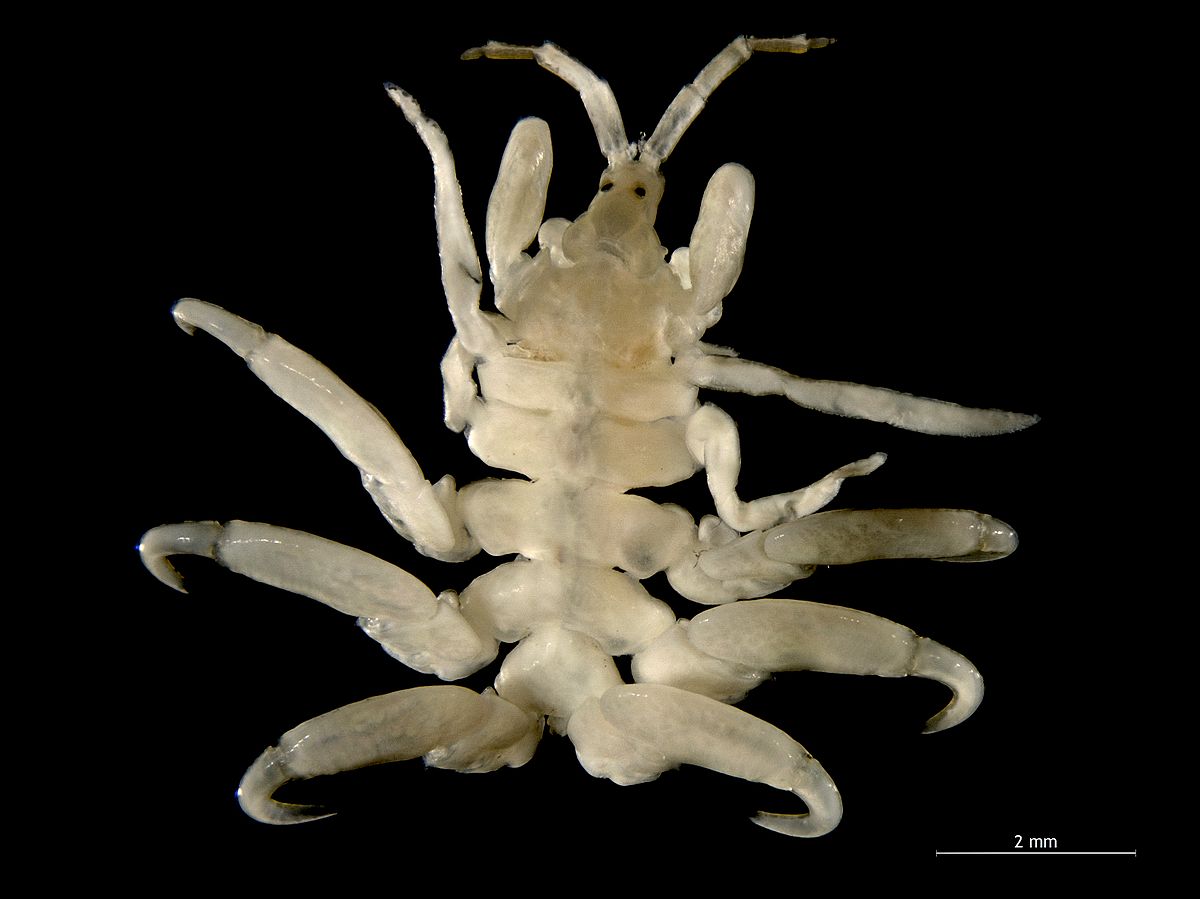
Cyamids are pelagic amphipods that live exclusively on the epidermis of whales. Not very much is known about them but research has shown that for the most part they are host-specific, meaning that each species of cyamid only infects one species of whale. This trend is more pronounced in Mysticetes than Odontocetes but only cyamids from the genus Cyamus have been found on Mysticetes where as all six genera of cyamids have been found on Odontocetes. These distributions are also reflected in migration patterns.
Cyamids are thought to spread between individual whales in three possible ways: nursing young, copulation and bodily contact while swimming. The first two happen much more frequently. They recruit as larvae in the water column, most likely by chemical cues. Cyamids have barbed appendages that help them burrow further into a whale’s skin. Gut analysis of cyamids suggest that they feed on the outer layer of skin which contains the pigments. They also feed on encrusting algae.

Aren’t you glad that there aren’t some parasitic larval amphipods floating around in the air, picking up on chemical cues from your skin and waiting to burrow into it and start feeding on your dead skin cells? Because I am.
Here is where I found most of the information:
http://crustacea.nhm.org/people/martin/publications/pdf/32.pdf
http://www.jstor.org/stable/pdfplus/3274363.pdf
Keep it real, y’all
-SL
==============================================
Rate Sean's blog (click here)
==============================================
It’s funny how certain animals can capture the minds and hearts of humans so effectively. History is littered with instances where this animal was held in near god-like reverence, briefly dropping out of favor during the age when they were viewed as pests by the fishing industry. How did humans come to empathize so strongly with this animal? Unlike the salmon, another important species in the Northwest, the orca is not exploited for food. Few people depend on the orca like they have depended on salmon. However, some combination of scarcity, size, inherent majesty and symbolism work to make the orca equally precious in our mind. Of course, part of it is “Free Willy” which humanized it in our eyes. Would that we could create a movie as meaningful for every threatened species. As long as we’re dreaming, would that we didn’t have such a concept as threatened species. Humans can have such a disproportionate impact on the environment. Today, we went to a desalinization plant for our sociology field trip and learned that an average shower uses roughly 60 gallons of water. There was a tank that held 75 gallons and it was relatively easy to visualize about how much water that is. It’s a lot. I view showering as an essential activity, however, and frequently (~4-6 times a week) do it. Thats 240-360 gallons of water just to keep me clean. Just one of many examples of the disproportionate impacts humans have. A lot of the time I hear about these statistics and figures and it makes me really pessimistic about the future. Sure, people are thinking about these issues and working to find a solution, but for every one of those people, there are 5 others that can’t be bothered by issues of water scarcity enough to change their daily consumption. How are orcas and other species that are depending on us to reduce our impact supposed to make it out in a world like this?
==============================================
Rate this review (click here)
==============================================
I would live at the whale museum if I could, surrounded by the skeletons, baleen, and echo of whales past. I don’t even know where to begin talking about what I learned and enjoyed there. Not much of the info that was presented was all that profound or new to me, but I did enjoy myself, maybe too much. I’ve done my fair share of nerding out on Orcas, so my apologies for spoiling the field trip for those of you who were les enthusiastic than me.
Orca, the charismatic mega fauna of the northwest, loved to the brink of extinction. The group most often encountered out here in the temperate waters of Washington state are known as the southern residents. Proved to be genetically different from any other type of orca, speciated long ago, these whales have developed a few special quirks when it comes to interacting with each other and humans.
Orca behavior
We’re all familiar with the typical behavior of whales from breaching, spy hopping, traveling and foraging, but what about the other less known characteristics?

back stroke

Transient double breach in Hood Canal

Kelping - swimming through the kelp, seen at Lime Kiln frequently
A few years ago, one resident pod member started a trend of wearing salmon on its head. The fashion statement caught on quite quickly and soon the rest of the southern pods were sporting the trend.

Orca wearing salmon
Northern residents have found their spa on a beach on Vancouver Island. They use the rocks on the beach for rubbing on. Culturally and functionally these rocks are an important place for the whales and are now protected in a marine sanctuary.

Vancouver Island rubbing rocks
Luna – humans and whales
The orca calf Luna became separated from L pod. When he was first observed missing, fatality was assumed. Later, he was discovered surviving on his own, miraculously, in Nootka sound, BC. Lacking the crucial interaction that young whales need, this whale turned to humanity. It’s amazing the turn of events that have happened over the course of history between orcas and humans. Hundreds of years ago, these whales were respected by the native nations, shot during the early 1900’s and captured in the 60’s, now they face the tragedy of loving them too much and being poisoned at the same time. Luna was a key player in either changing humanities view of orcas or bringing about hostile views. The first nations of Nootka sound where the calf was living believed it was their recently deceased chief returning to them in the form of the Orca to help the tribe become stronger. Luna’s interactions with people included coming right up to the boat and wanting to be touched, playing fetch, and caused destruction to many a boat. The whale attempted to call his family everyday, but there was never an answer. He was quickly loosing his ability to ‘speak whale’ and function in a pod setting. Many attempts to return him to Puget sound to be near his family pod ended in failure. Unfortunately Luna’s story is not a happy ending, he was caught in a tug boat propeller before we could learn anymore from him.
I highly recommend two documentaries about the whale, Saving Luna and Luna: sprit of the whale. The latter is playing this Friday in the commons at 4:30 and I recommend that everyone go and see it.
Remember to save the whales! -Liza

P.S. Free Lolita

Lolita - one of the last living captured southern residents still in captivity in Miami.
==============================================
Rate this review (click here)
==============================================
As I’ve said to several of you, you don’t have to decide between being an invert person or a mammal lover; you can be both! Just study whale falls. I find them absolutely amazing. Almost immediately upon sinking, hagfish to amphipods to sleeper sharks converge to this feast of the deep removing from 40 to 60 kilograms/day. An average sized whale can be striped to the bone within a few months. After a year, the whale bones and organically enriched sediment host 1000′s of polychaete worms (some estimates of up to 45,000 per square meter), crustaceans and molluscs. Many of these whale fall specialists are new to science so if you study these perhaps you’d get to name your own species.
A year or two after the whale fall, when the organic matter has been consumed, sulfur reducing bacteria will feed on the fats and oils deep within the whale bones. This third stage is a self contained food web getting most of its energy from chemosynthetic bacteria. These are animals that graze on the chemosynthetic bacteria as well as critters that live off the bacteria living within their own bodies. This stage may have up to 190 species of macroscopic animals feasting on a single whale. At least one of these whale falls has lasted 50 years.
Thirty million year old piles of fossil whale bones and clams hint that whale falls have been happening as long as there have been whales. And they might not be all that uncommon today. Craig Smith (University of Hawaii) estimates there may be a dead whale every 5 to 16 km along the seafloor of the Pacific. Another estimate gives the number of active whale falls in the world’s oceans as 600,000 at any one time. The environmental problem here is that whaling has reduced whale populations by up to 75% in some of the world’s oceans meaning whale fall specialist that have evolved over millions of years may be facing extinction due to lack of ‘habitat.’
For a video of a whale see the following web site: http://www.youtube.com/watch?v=vQbGk4sHROg
Info for this blog came mainly from an online article by Kim Fulton-Bennett , Whale falls – islands of abundance and diversity in the deep sea and also the book The Deep by Claire Nouvian.
Were I to chose a marine biology topic I’d really like to study, whale falls would surely be at or near the top of the list.
Phil
==============================================
Rate this review (click here)
==============================================